Crypto Vaults: How They Work, Eight Types, and a Risk Checklist
Crypto vaults explained across custody, ERC-4626 yield, lending, LP, staking, options, perp, and RWA structures, with a pre-deposit checklist.

DeFi Farmer Research Desk
Aug 26, 2026 · 13 min read
In brief. A crypto vault can mean secure custody or an onchain strategy that accepts assets and issues shares. Identify the vault type, yield source, manager powers, withdrawal mechanics, fees, and every protocol dependency before depositing.
On this page20 sections
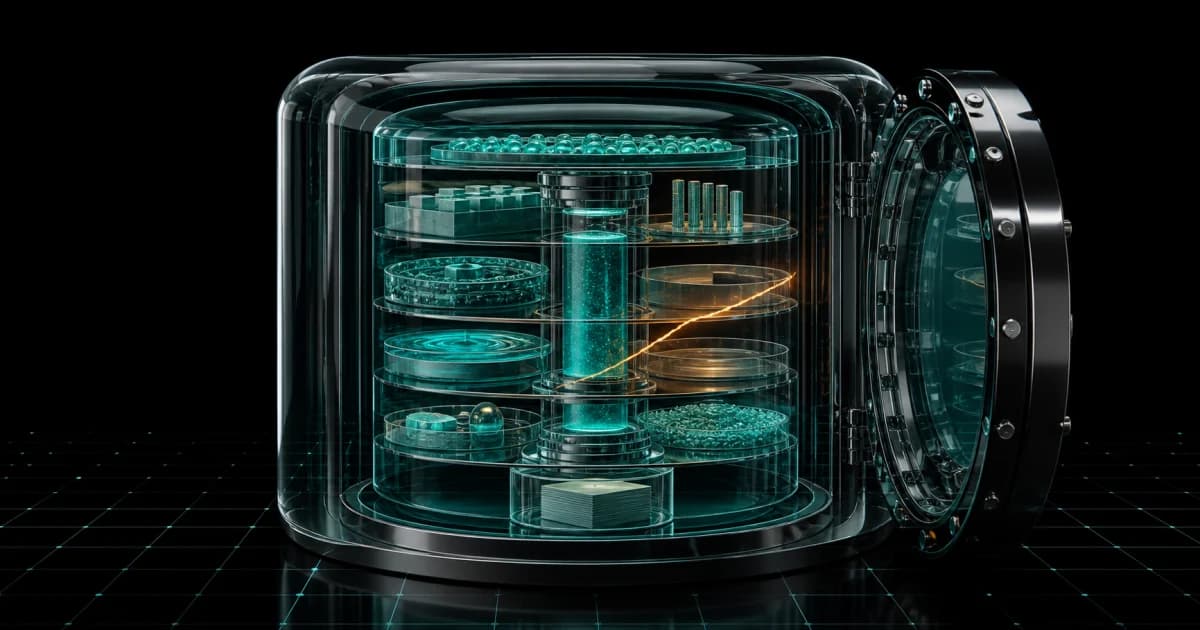
Crypto vaults can hide a surprising amount of machinery behind one Deposit button. Some secure keys or delay withdrawals. Others issue tokenized shares and route capital into lending, liquidity pools, staking, options, perpetual trading, or offchain credit. Identify which kind you opened before comparing APY.
Use it before approving a token or moving funds into any vault contract.
Start with the word “vault”
In ordinary language, a vault protects something already valuable. Crypto products borrowed the word and stretched it.
A custody vault secures private keys or assets through controls such as multisignature authorization, withdrawal delays, address allowlists, hardware isolation, or institutional custody procedures. Its primary job is safekeeping.
A DeFi vault usually accepts an underlying token, issues shares, and deploys the token according to a strategy. Its job is capital allocation. Security matters, though the user also inherits economic risk from whatever the strategy does.
Exchange vaults can add a third meaning. A trader or automated strategy manages deposited capital and shares profit and loss with depositors. Hyperliquid vaults are an example.
Ask for the verb. Does the vault store, lend, stake, trade, rebalance, bridge, write options, or finance offchain assets? The answer exposes the risk surface quickly.
ERC-4626 in plain English
Ethereum's ERC-4626 standard defines a common interface for tokenized vault shares backed by one ERC-20 asset.
If you deposit 1,000 USDC, a vault might mint 1,000 shares when the initial exchange rate is one USDC per share. As the strategy earns net income, total assets could rise to 1,050 USDC while the share count stays at 1,000. Each share would then represent 1.05 USDC.
Losses work through the same ratio. If assets fall to 900 USDC, one share represents 0.90 USDC.
- 01
Approve
The user authorizes the vault contract to move a chosen amount of the underlying ERC-20 token.
- 02
Deposit
The vault receives assets and mints shares according to the current conversion rate.
- 03
Allocate
A strategy or manager deploys capital into lending, staking, trading, LP, or another activity.
- 04
Redeem
Shares burn and the vault returns available assets after fees, liquidity limits, and strategy results.
The standard exposes methods such as deposit, mint, withdraw, and redeem. It also provides preview and maximum-operation functions so interfaces can estimate shares and assets.
The specification deliberately leaves strategy details outside the interface. It describes vaults as black boxes that must be inspected offchain. That sentence should sit beside every ERC-4626 badge. Compatibility tells an app how to call the contract; it does not grade the assets inside.
The video walks through deposit, mint, withdraw, and redeem flows. Watch the transition into asynchronous ERC-7540 requests around the middle if you are evaluating a vault with delayed redemptions.
Eight crypto vault types
1. Custody and security vaults
These products focus on key protection and controlled withdrawals. A personal setup might use a multisignature wallet plus hardware signers stored in separate places. An institutional product may add policy engines, insurance terms, and approval workflows.
Check who controls recovery, whether administrators can change allowlists, how delays work, and what the insurance excludes. “Cold” storage still needs a path for authorized movement.
2. Lending and curated credit vaults
Deposits flow into lending markets. Borrower interest provides the basic yield.
Morpho vaults add a curator layer that chooses approved markets, sets supply caps, and allocates liquidity. Its curator documentation describes caps plus supply and withdrawal queues. Curators can direct exposure within configured boundaries, and timelocks delay sensitive changes.
Inspect collateral assets, loan-to-value settings, oracle design, liquidation liquidity, caps, curator identity, guardian powers, and the timelock. Our Morpho Vault guide covers those fields one by one.
3. Automated yield strategy vaults
These vaults move funds among farms or lending venues, harvest rewards, swap them, and compound the result. Yearn popularized the pattern.
Automation saves gas and repetitive work. It also creates a dependency chain. A vault using three protocols and two reward-token swaps can fail through any underlying contract, oracle, router, or liquidity pool.
4. Liquidity-management vaults
Concentrated-liquidity positions require price ranges and rebalancing. A managed LP vault chooses ranges, collects fees, and shifts inventory.
Users still face divergence from simply holding the assets. A narrow range can earn more fees while active and convert quickly into the weaker asset during a trend. Use the impermanent loss calculator before assuming the quoted fee APR is profit.
5. Liquid staking and restaking vaults
Staking vaults delegate assets to validators and issue a receipt. Rewards may accrue through a rebasing balance or a rising exchange rate.
Risks include slashing, validator concentration, smart contracts, withdrawal queues, and the market price of the receipt token. Restaking adds another service layer with additional slashing or operator conditions. Read what liquid staking is before stacking the receipt into more DeFi positions.
6. Options and structured-product vaults
An options vault might sell covered calls, puts, or more complex volatility strategies. Premium income can look steady until the underlying moves through the strike.
Read the payoff diagram, collateral terms, settlement price, rollover schedule, and whether positions can be closed early. Annualized premium is a weak description of a strategy with infrequent large losses.
7. Perpetual exchange liquidity vaults
These pools or strategies support leveraged traders through market making, liquidations, or direct peer-to-pool backing.
When traders win, vault value can fall. When traders lose, the vault may benefit. Fee income compensates depositors for this role. The LP-to-trader counterparty risk guide explains the transfer with worked examples.
8. Real-world asset and asynchronous vaults
RWA vaults can hold tokenized Treasury exposure, private credit, invoices, or fund shares. The blockchain share is only one layer. Offchain custodians, banks, administrators, legal entities, valuation agents, and redemption calendars sit underneath.
Immediate ERC-4626 withdrawals do not fit every offchain asset. Extensions such as ERC-7540 support request-based deposits and redemptions. A pending request introduces time, discretion, and liquidity mismatch that a simple share price cannot express.
Where vault yield comes from
Every rate has a payer.
| Yield source | Payer or economic source | Main failure path |
|---|---|---|
| Lending | Borrowers | Bad debt after weak collateral or failed liquidation |
| Staking | Network issuance and transaction fees | Slashing, validator failure, receipt-token discount |
| Trading fees | Swappers or derivatives traders | Volume falls or strategy loses inventory value |
| Option premium | Option buyers | Large underlying move overwhelms collected premium |
| Basis and funding | Leveraged traders | Spread closes slowly, funding reverses, hedge fails |
| Token incentives | Protocol treasury or emissions | Reward price falls or program ends |
| RWA income | Treasury, borrower, or issuer cash flow | Default, custody, legal, and redemption delay |
If a dashboard combines several sources into one APY, separate them before comparing vaults. The stablecoin yield guide gives a four-source framework for dollar-denominated products.
Share price, APY, and fees
A rising share price can reflect strategy income, token price changes, donations, accounting updates, or delayed loss recognition. Look at total assets and share supply together.
Fees may include deposit charges, withdrawal charges, annual management fees, performance fees, strategy fees, and swap costs inside the vault. ERC-4626 allows fees; the standard does not require one universal fee policy.
Suppose a USDC vault earns 10% gross over a year, charges a 1% management fee on assets, and takes 15% of remaining performance. A simplified $10,000 deposit earns $1,000 gross. After $100 management and $135 performance fee, net gain is $765, before transaction and withdrawal costs.
The displayed 10% became 7.65% in that example.
Performance-fee formulas differ. Some use a high-water mark, some charge only realized gains, and others accrue continuously. Find the contract or documentation formula.
The manager and curator layer
Code executes choices that someone defined.
A curator may approve markets. An allocator shifts liquidity. A guardian can cancel a pending change. An owner may replace roles or alter fees. A strategy manager can rebalance positions. Multisigs often control upgrades and emergency actions.
Map each address to a power.
Then inspect delay. A 72-hour timelock gives depositors a window to react to a cap increase or market addition, provided someone monitors the event and withdrawals remain available. A same-block change gives no such breathing room.
I open the role and capability page first, then the withdrawal queue. On Morpho, the allocator can move capital within curator-set bounds, while cap changes pass through a timelock. That tells me more about tomorrow's exposure than yesterday's annualized return.
Withdrawal mechanics
Pressing Withdraw can trigger several different paths.
An idle vault pays immediately from cash. A lending vault may pull from the first liquid market in its withdrawal queue. A strategy vault may unwind LP positions or swaps. An RWA product may create a request that settles later.
Check these details.
- Is there a cooldown or notice period?
- The maximum amount redeemable now, available through
maxWithdrawor the interface. - Queue order. Which market gets drained first, and can a later market become stuck?
- Withdrawal fees and price impact.
- Whether shares can trade elsewhere, plus the depth of that secondary market.
- What happens when the underlying protocol pauses.
Vault shares can remain transferable while direct redemption is constrained. Selling the share may require accepting a discount.
Smart-contract risks unique to vaults
The wrapper adds accounting hazards beyond the underlying strategy.
Inflation or donation attacks can manipulate an empty or nearly empty vault's share exchange rate. OpenZeppelin's ERC-4626 guidance discusses defenses such as virtual shares and assets.
Rounding matters for small deposits. The standard generally favors the vault during calculations, which can cause tiny users to receive fewer shares than expected.
Preview functions may differ from execution because state changes between quote and transaction. Deposit caps, withdrawal limits, fees, and slippage all matter.
Upgradeable vaults can change behavior after an audit. Immutable vaults avoid that particular path and cannot patch a newly discovered flaw without migration.
Crypto vault checklist
Name the vault type
Write one sentence describing what happens after deposit. Include every protocol, chain, asset, and offchain party involved.
Identify the yield payer
Separate interest, fees, funding, staking issuance, option premium, incentives, and asset appreciation.
Map roles and change delays
Record owners, curators, allocators, guardians, upgrade administrators, multisig thresholds, and timelocks.
Inspect the assets and liabilities
Verify underlying token addresses, collateral, leverage, open positions, debt, oracle sources, and concentration limits.
Calculate net return
Subtract management, performance, withdrawal, swap, bridge, and gas costs. Compare against simply holding the underlying asset.
Test a withdrawal
Use a small amount. Record the cooldown, queue, received token, exchange rate, transaction approvals, and time to completion.
Verify security evidence
Read audit scope and dates, bug bounty terms, incident history, upgrade status, and contract addresses from primary sources.
Common vault mistakes
- Choosing the highest APY without identifying the payer.
- Assuming ERC-4626 certification exists. It is an interface standard rather than a safety approval.
- Counting reward-token emissions at their current price for a full year.
- Ignoring the vault share's market discount.
- Diversifying across vaults that all use the same stablecoin and oracle.
- Reading TVL as proof that withdrawals will remain liquid.
- Approving an unlimited token amount and leaving it active after exit.
- Treating a curator's reputation as a substitute for enforceable caps and timelocks.
A vault can stack hidden dependencies
A USDC vault may lend through a market that accepts a bridged collateral token priced by an oracle and managed by an upgradeable curator. Five logos on one screen can represent one tightly connected failure path.
Three things to keep
- A screenshot or note of roles, fees, and withdrawal terms from the deposit date.
- The official contract address and underlying token address.
- Enough native gas outside the vault to revoke approvals and exit.
Crypto vaults FAQ
›What is a crypto vault?
The term can describe a secure custody arrangement or an onchain product that accepts assets and issues shares in a strategy. DeFi vaults may lend, stake, trade, provide liquidity, or finance offchain assets.
›Are crypto vaults safe?
Safety depends on the contracts, assets, strategy, manager powers, oracles, leverage, and withdrawal path. Audits and standards reduce specific risks but cannot guarantee the return of funds.
›What is an ERC-4626 vault?
It is a tokenized vault following a standard interface for one underlying ERC-20 asset. Deposits mint shares and redemptions burn shares. Strategy design and risk remain specific to the vault.
›Can a vault share lose value?
Yes. Bad debt, trading losses, slashing, depegs, contract exploits, fees, or offchain defaults can reduce the assets backing each share.
›Why can a vault withdrawal be delayed?
Capital may be deployed into loans, staking queues, LP positions, trading strategies, or offchain assets. Some vaults also impose cooldowns or request-based redemption periods.
›How should two vault APYs be compared?
Separate each yield source, subtract every fee, compare underlying asset exposure, review drawdown, and test withdrawal liquidity. Use the same measurement period for both vaults.
Sources
- ERC-4626 specification for the official tokenized-vault interface and security considerations.
- OpenZeppelin ERC-4626 documentation for share accounting and inflation-attack defenses.
- Morpho curator documentation for caps, allocation, and withdrawal queues.
- GMX liquidity documentation for perpetual liquidity vault mechanics.
- Gains Network gToken vaults for ERC-4626 trader-counterparty vaults.
Vault automation changes who operates the strategy. Contract, oracle, liquidation, depeg, bridge, and withdrawal risks still need their own checks.
Keep reading
Related research

LP-to-Trader Model in DeFi Perpetual Exchanges: Counterparty Risk
How the LP-to-trader perp model transfers trader profit, loss, inventory, oracle, and withdrawal risk into liquidity pools, with worked examples.

What Is Liquid Staking
Liquid staking issues a tradable receipt token for staked assets so capital stays usable. How LSTs accrue value, the two different exits, and why the peg is the risk that matters.
Morpho Vault
How a Morpho vault works, what the curator actually controls, and the seven parameters to check before depositing — LLTV, oracle, supply caps, timelock, guardian, fee, and concentration.

Stablecoin Yield
Where stablecoin yield actually comes from — lending demand, basis trades, T-bills, and emissions — what each one can lose, and why US regulation pushed the yield into wrappers.
Get the next field guide
New protocol research, risk checks, and practical DeFi tools.