Is Onyxcoin Dead? 7 Checks Beyond the XCN Price
Is Onyxcoin dead? Check a recorded XCN transfer, current proposals, audit limits, and the questions that still matter before buying or holding.

DeFi Farmer Research Desk
Sep 8, 2026 · 12 min read
In brief. Our September 8 check found advancing blocks on the official Onyx explorer, current documentation, and a public governance interface. That argues against a simple abandoned-project label, but does not prove adoption, safety, or a price recovery.
On this page12 sections
Is Onyxcoin dead? The activity checked on September 8, 2026 does not support calling it abandoned. The explorer showed advancing blocks and a successful XCN transfer. The governance app had current proposals. I would not call that dead. I would also not treat it as a reason to buy: activity alone does not establish demand, security, or a future price recovery.
Use these seven checks to separate a working network from a worthwhile investment. Those are different questions. A token can lose value while its network continues to operate.
This review covers public records and interfaces. It does not include trading, staking, voting, running a validator, or a code audit.
What the Records Show
| Question | Evidence at our check | Limit |
|---|---|---|
| Was the explorer reporting new blocks? | Latest block advanced from 15,106,194 to 15,106,297 | Two explorer observations, not independent node validation |
| Was there public project information? | Official site, documentation, and governance interface were reachable | Published pages do not prove all advertised features are delivered |
| Was every sampled block busy? | The first three latest blocks in each API observation had zero transactions | A tiny recent sample cannot describe daily use |
| Was current adoption independently measured? | No | Addresses, transactions, and real users need separate analysis |
| Was a future price recovery established? | No | No technical activity check predicts a market price |
Sources: official Onyx website, explorer, public blocks API, and governance interface. The API endpoint is live; its latest results will change.
1. Identify the Asset and the Version
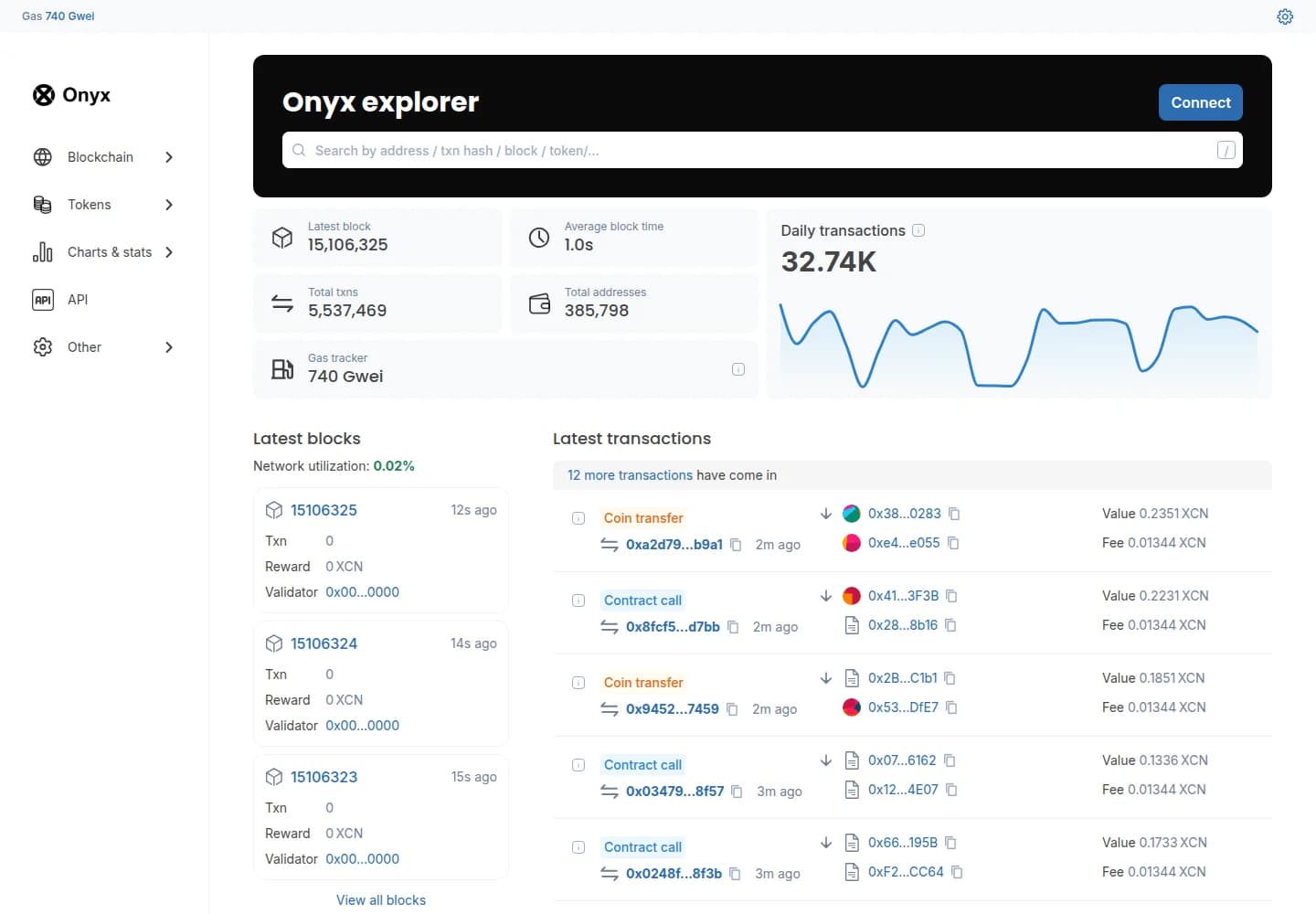
Start with what "Onyx" means in the source you are reading. The current official site describes an XCN-based blockchain. Older material can concern other parts of the project's history or Ethereum contracts. Do not combine those descriptions into one architecture without checking dates and scope. Current project description
Record the network, token contract where applicable, application URL, and date of each claim. Do not copy an address from an unsolicited message. Use the official documentation and verify it against the relevant explorer.
If you hold XCN on an exchange, do not assume a native-chain staking tutorial applies to that balance. Check the withdrawal network first.
If you cannot identify the asset or contract, stop. You may be reading about a different system from the one that holds your funds. The network directory and bridging guide explain why the chain matters.
2. Check Blocks and Transactions Separately
We made two requests to the official explorer's public block endpoint:
| Observation | Latest reported block | Block timestamp, UTC | Transactions in that block |
|---|---|---|---|
| First API response | 15,106,194 | September 8, 2026, 18:52:35 | 0 |
| Second API response | 15,106,297 | September 8, 2026, 18:54:18 | 0 |
The second response was retrieved at 18:54:26 UTC. The reported head advanced by 103 blocks, with 103 seconds between those block timestamps. This is a narrow observation of the explorer, not a throughput benchmark. Live block API
One entry under Latest transactions gave a more useful detail. Its receipt showed Success, block 15,114,249, a value of 0.2136 XCN, and a fee of 0.01344 XCN. The timestamp was September 8 at 21:06:50 UTC. This was a public record, not a transfer we made.
The receipt is why I would not judge activity from the newest block alone. Status, sender, receiver, and fee were easy to inspect together. Three empty blocks on the homepage did not mean there were no recorded transfers. But one receipt cannot establish user demand.
When the newest block has zero transactions, check earlier blocks and the transaction list. Blocks can continue to arrive without much demand to use them.
Failure case: an explorer stops updating. Compare another trusted endpoint or node and official incident reports. The problem could be the explorer, its indexer, the connection, or the network. Do not choose a cause from a frozen page alone.
3. Check Delivered Work, Not Announcement Volume
A roadmap is a list of intentions. Better evidence includes a released version, accessible source code, deployment addresses, reproducible instructions, and a working feature tied to that release.
The official site describes a sovereign Layer 1 and publishes performance claims. We did not reproduce those claims or verify a current validator build. Treat them as project statements, not our measurements. Official product claims
For a release, record its date, version, code reference, deployment, and known issues. Check that the repository really belongs to this project. A GitHub result with "Onyx" in its name can be unrelated.
For a treasury review, ask a technical reviewer to match each announcement to the deployed version and test the feature. Counting posts or commits will not tell you whether it works.
The documentation is available. Development pace and full roadmap delivery remain unverified here. I would leave those questions open rather than score them from announcements.
4. Separate the Two Governance Systems
The current documentation distinguishes Ethereum governance from Onyx Chain governance. It says native-chain voting uses stXCN and that voting power does not cross between the two systems. It also says activation is staged. Treat that rollout wording with care: the live app already showed four proposals under its Onyx view, all marked Executed. Governance documentation and live app
We entered OIP-4 in the proposal search. The list narrowed to Acquisition of Chain Technology and Intellectual Property, dated September 2, 2026. It displayed 1.30 billion XCN For and 0.08 XCN Against. Opening the proposal showed separate address lists, a quorum bar, and a dated execution timeline. These are displayed voting weights and addresses, not counts of independent people.
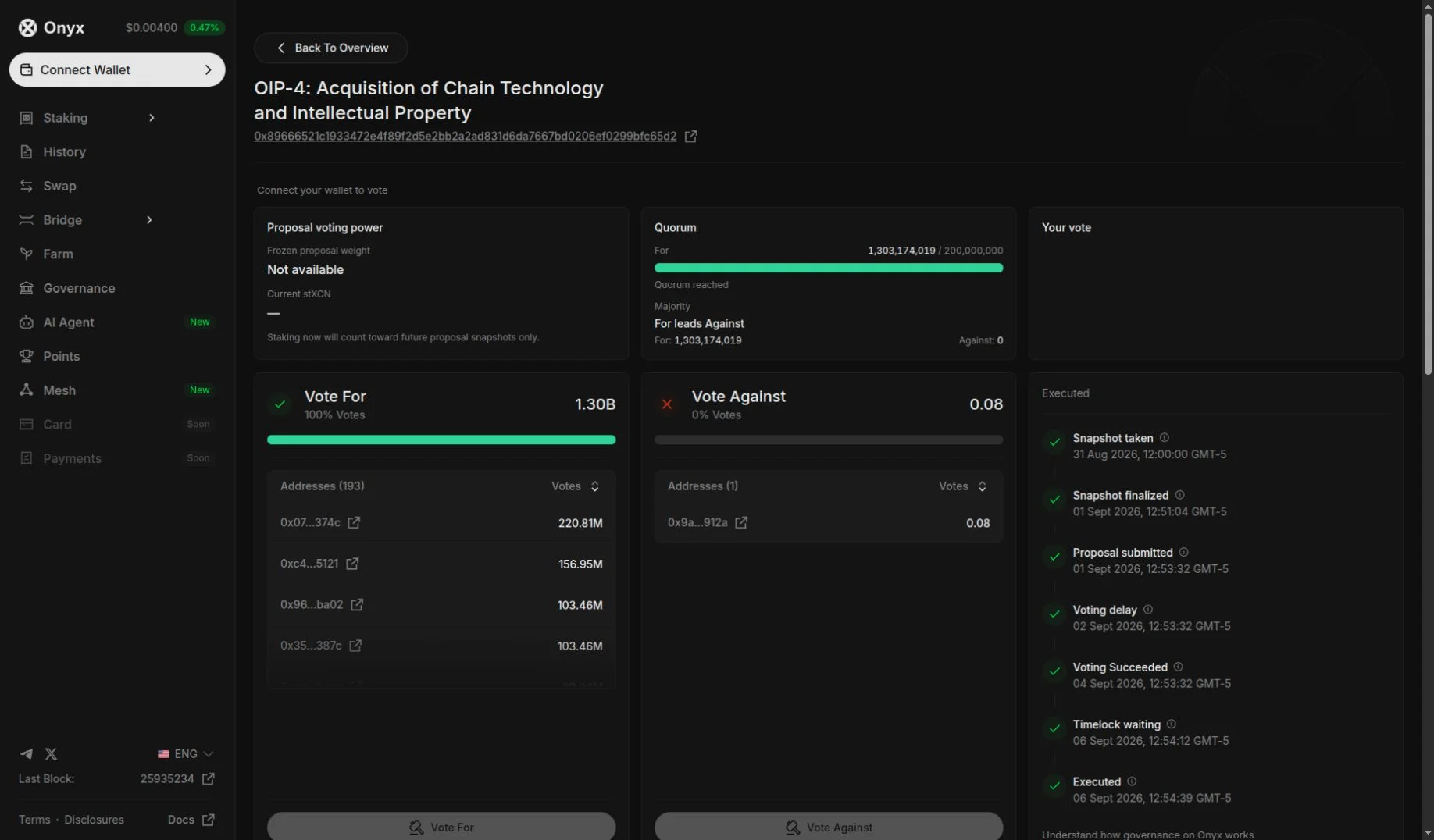
Open the full-size proposal screenshot.
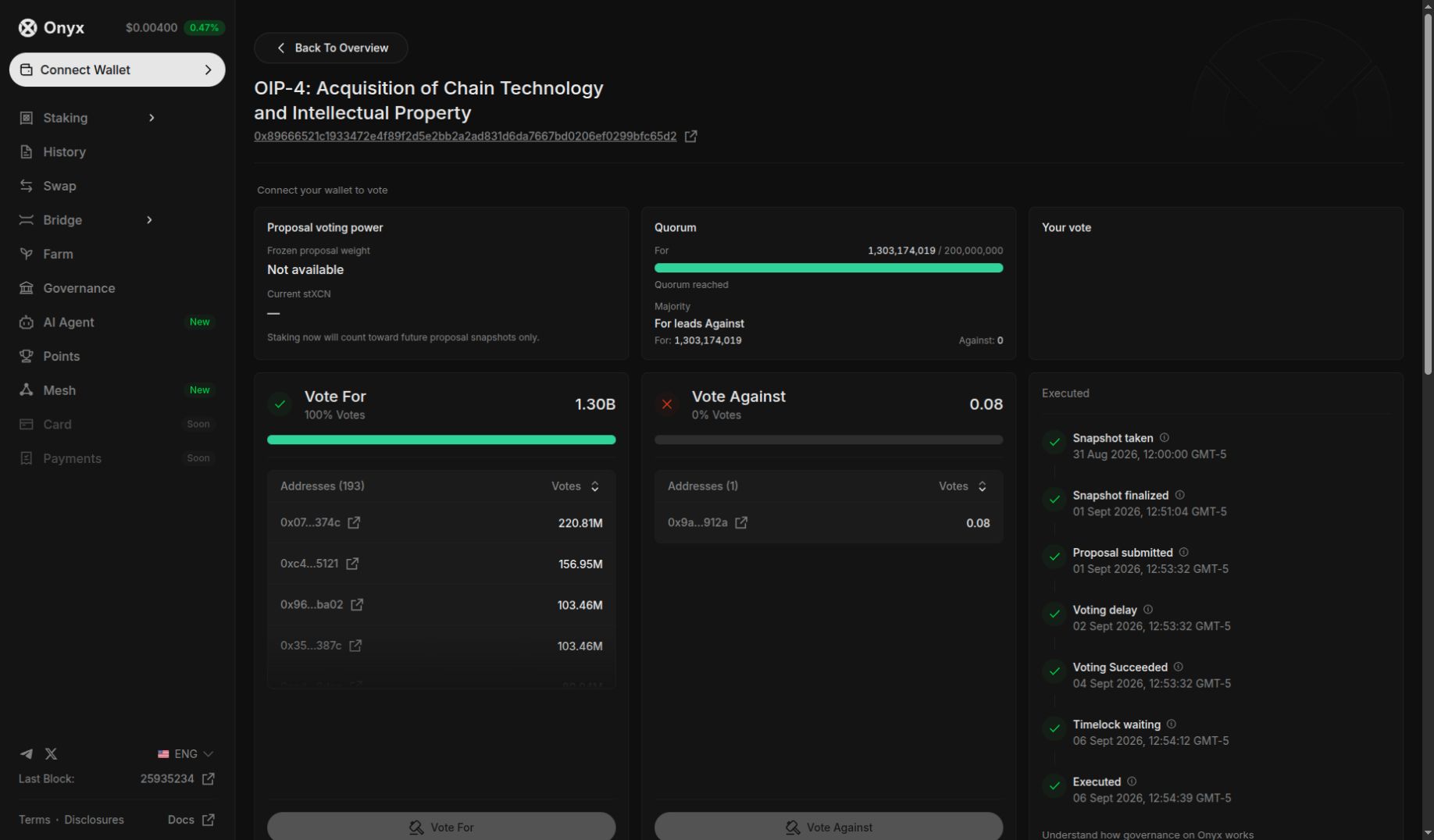
The proposal search works, but the gap between the app and the documentation is frustrating. I would want those pages to agree before relying on a rollout description. OIP-4 includes conditions and future integration work. Executed does not mean the acquisition closed or its products shipped. The app still marked Card and Payments Soon.
This matters more than a simple "DAO active" label. A proposal page can show discussion, voting, or execution on a different chain from the one you assumed.
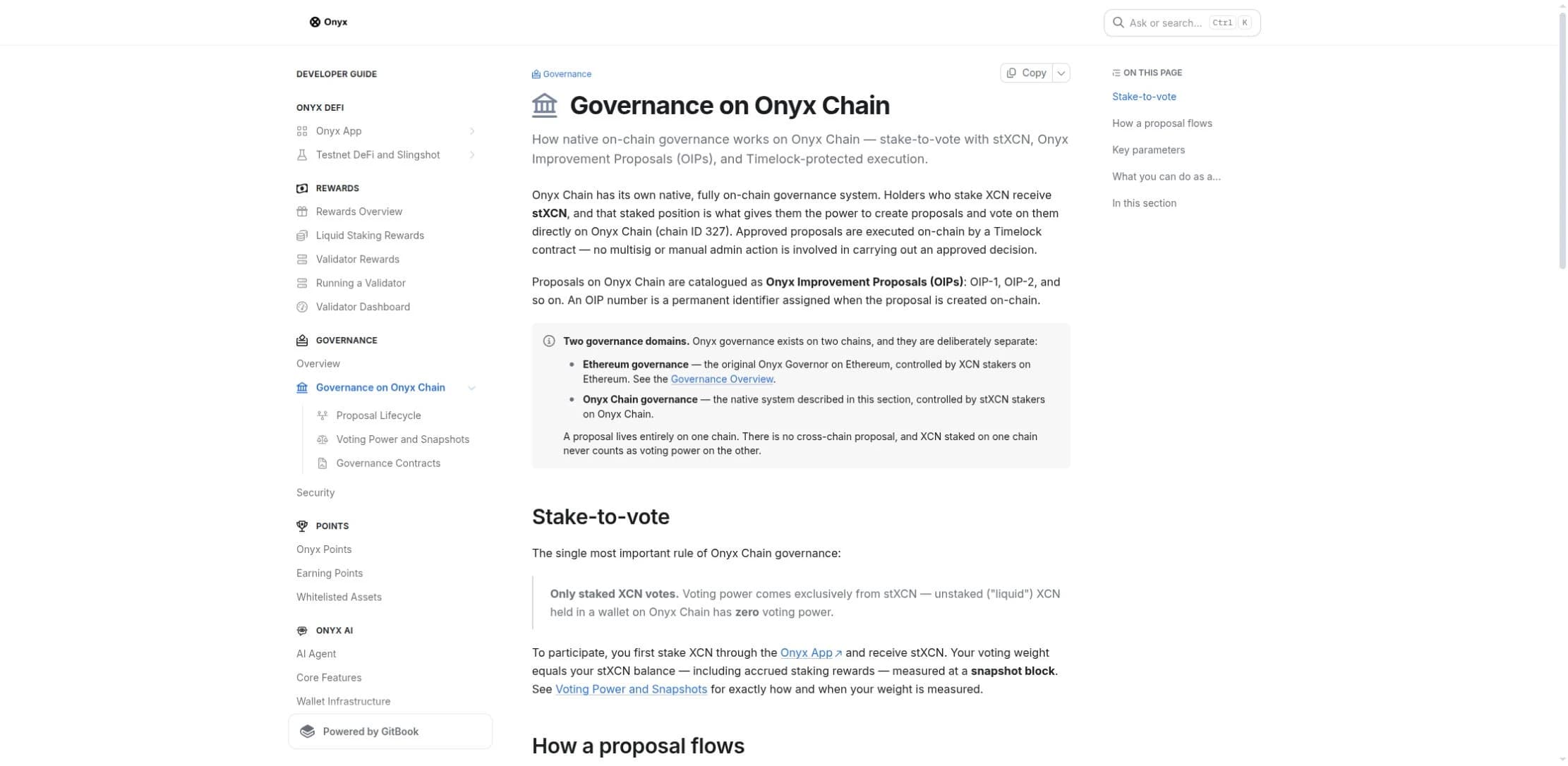
Open the full-size governance screenshot.
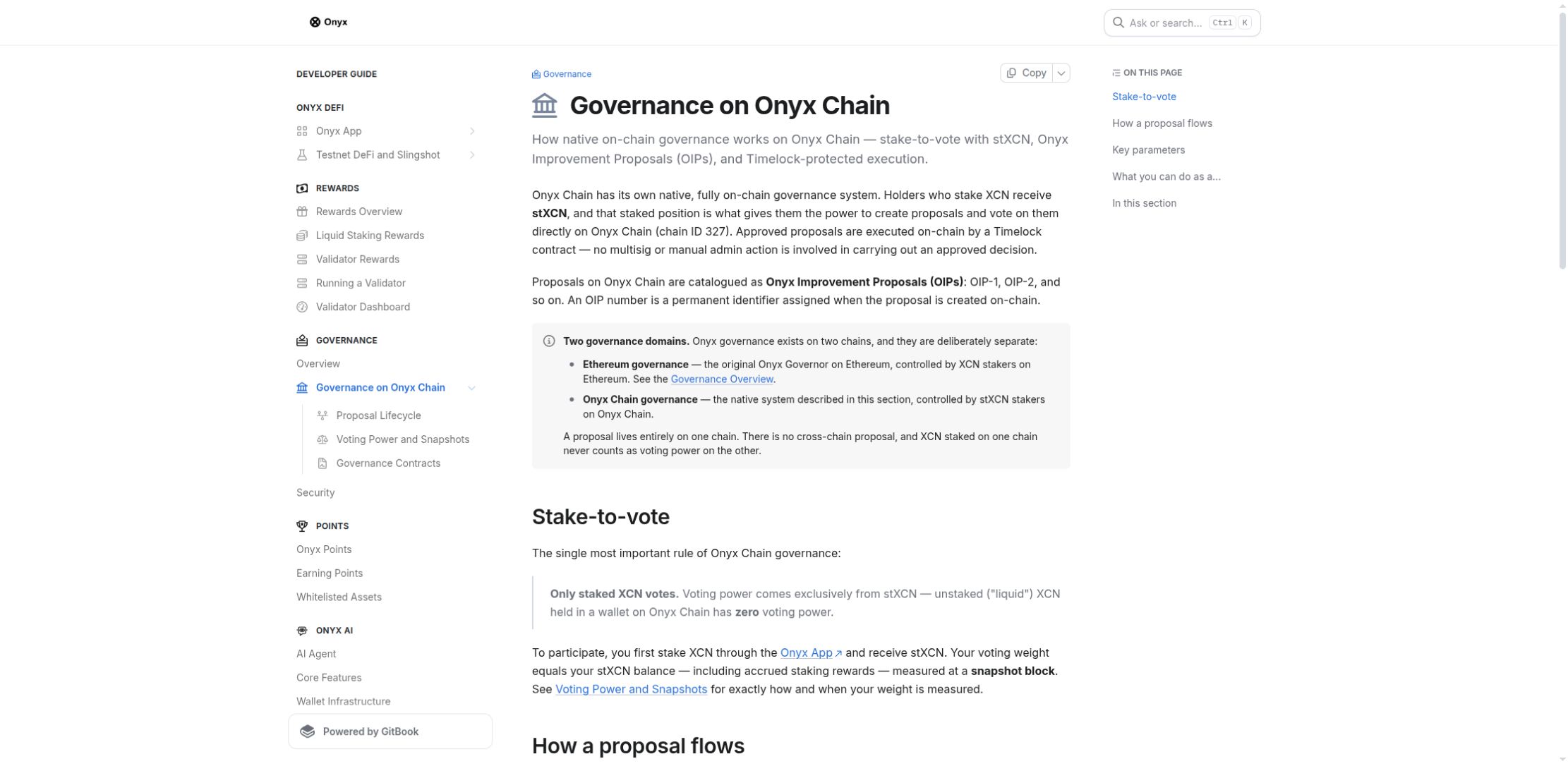
For a proposal, record the chain, proposal ID, voting period, vote concentration, status, and execution transaction. Do not mark a passed vote as executed without the corresponding evidence.
For a proposed reward change, check the chain and the execution record. A proposed rate is not an active rate.
The app provides dated proposal records. Their execution transactions and the holders behind the voting weights were not verified in this review. Those records alone cannot establish broad participation or completed delivery.
5. Check Whether Liquidity Matches Your Question
A listed price answers less than many readers expect. Ask whether the exact asset can be traded and withdrawn through a service you are permitted to use. Then examine depth for the amount under consideration.
The official Onyx site links an XCN/USD market on Coinbase Exchange. That link is a place to check market information, not proof that your account, state, order size, or withdrawal route is eligible. We did not inspect a live executable order for a US customer.
For an order book, inspect bids and asks near the intended size. For a pool, inspect the route and its quoted price impact. Reported volume is not a promise that you can exit at the last price.
Hypothetical example: a screen values a holding at $1,000, but a quote for the full sale would return $920 before an additional network cost. The displayed valuation and expected proceeds are different measures. Neither number is a current XCN quote.
Our meme coin tracking tool comparison explains common dashboard mistakes that also apply to other tokens. Use the crypto profit calculator for arithmetic, not to infer that a sale will execute.
6. Check Supply and the Source of Rewards
Ask where rewards come from: fees, existing treasury tokens, new issuance, or another source. A high token-denominated reward rate does not establish a positive USD return.
Reconcile circulating supply, total supply, unlocks, treasury movements, and burns using dated records. Do not subtract a planned burn as though it already happened. Do not mix two providers' supply definitions without explaining the difference.
Hypothetical reward example: a balance grows from 1,000 to 1,100 tokens. If the token price falls from $1 to $0.50, its gross value becomes $550, not a 10% dollar gain. This illustrates arithmetic only; it is not an XCN rate or forecast.
Record the reward contract, funding source, withdrawal rules, and who can change them. Ask a qualified technical reviewer for help if the controls are unclear. The yield farming risk guide explains the broader risks.
Current XCN supply and reward sustainability were not independently verified here. I would want those answers before forming an investment view. A live explorer cannot supply them.
7. Read the Audit Scope and Unresolved Findings
The official site links a Halborn governance report. Its engagement ran from February 12 to February 21, 2025 and covered four Solidity files associated with governance, staking, rewards, and timelock functions. It is not a blanket assessment of every current Onyx component. Halborn governance audit
The displayed findings include risk-accepted and acknowledged items, plus a pending informational item. Do not translate "addressed" into "every finding fixed." The report also excludes later implementations and certain other areas from scope.
For any audit, match the assessed code and contracts to the system you would use. Check remediation evidence, upgrade powers, and changes since the assessment. A staking-contract report does not automatically cover a bridge, wallet interface, validator system, or later governance deployment.
Failure case: a site displays an auditor's logo but links an old or different report. Mark the current component unverified. Do not invent a security grade from the logo.
Past incidents also need exact protocol and contract attribution. We did not establish a complete incident history or remediation audit here. Use our crypto due-diligence guide to structure that follow-up, not a rumor thread.
Make a Decision From Evidence, Not a Label
| Evidence pattern | Reasonable interpretation | Unjustified conclusion |
|---|---|---|
| Advancing blocks, little verified usage | The observed network is producing blocks | The token must rise |
| Active proposals, concentrated votes | Governance exists but control needs review | Every holder has equal influence |
| Low price, current delivery | Market performance and development differ | Recovery is guaranteed |
| Strong marketing, missing release evidence | Delivery remains unverified | A roadmap proves completion |
| Stale explorer, no independent check | Availability is unresolved | The whole chain is dead |
My conclusion is narrower than either "dead" or "ready to recover": the records show operation, but several investment questions remain unanswered. Demand, supply, liquidity, and current audit coverage still need work. "Still operating" is not a recommendation to buy or hold.
Printable XCN Review Checklist
- Identify the exact asset, network, and contract where applicable.
- Record the source URLs and UTC check time.
- Compare block progress across more than one observation.
- Separate transactions from independent users and economic demand.
- Match announcements to released and deployed work.
- Identify the governance chain and actual execution status.
- Check eligible trading access, depth, and withdrawal support.
- Reconcile supply changes and reward funding.
- Match audit scope and remediation to the current component.
- Keep unanswered questions visible in the final decision.
If You Only Do 3 Things
- Identify the exact network and verify current activity.
- Separate delivered work from proposals and marketing claims.
- Review liquidity, supply, and security before treating activity as investment evidence.
Sources and Editorial Limits
The activity figures come from the official explorer, not an independently operated node. The audit findings come from Halborn's linked report. The reward and sale examples use hypothetical numbers, not current XCN quotes.
This article is not personal investment advice. Speak with a qualified adviser before making a decision involving essential savings or a concentrated position. For wallet handling, see self-custody basics and seed phrase storage.
FAQ
›Is Onyxcoin abandoned?
Our September 8, 2026 check found advancing blocks on the official explorer and reachable project and governance pages. This argues against a simple abandonment claim, but does not prove strong adoption or investment value.
›Do empty blocks mean Onyx has no users?
No. A few empty blocks are a small sample. Check transactions over a defined period and distinguish addresses, automated activity, and independent users.
›Is Onyx Chain governance the same as Ethereum governance?
No. The official documentation describes separate governance domains and a staged native-chain rollout. Check the proposal's chain, voting rules, and execution record.
›Does continued development mean XCN will recover?
No. Development, adoption, supply, liquidity, and market prices are different factors. This review does not establish a future XCN price.
Keep reading
Related research

5 Best Meme Coin Tracking Tools: Charts and Risk Checks
Compare five meme coin tracking tools, with BONK search results, Memescope filters, risk warnings, and clear reasons to choose or skip each one.

Rug Pull Check
How to run a rug pull check that actually works: the seven on-chain conditions scanners test, which tool covers which chain, and the four failure modes no scanner can see.

Yield Farming Risks
Yield farming risks include contract failure, admin control, oracle errors, liquidation, depegs, impermanent loss, bridges, and blocked withdrawals.
Get the next field guide
New protocol research, risk checks, and practical DeFi tools.