Dogechain Bridge
Use the Dogechain bridge with clear steps, custody and signer risks, the 100 DOGE minimum, confirmation rules, fees, and withdrawal troubleshooting.

DeFi Farmer Research Desk
Aug 29, 2026 · 13 min read
In brief. Dogechain's DOGE bridge is a centralized lock-and-mint bridge. It takes native DOGE, waits for Dogecoin confirmations, and mints a representation on Dogechain. Verify the current minimum and bridge status, use only DOGE, test first, and understand that withdrawals can wait for hot-wallet liquidity.
On this page17 sections
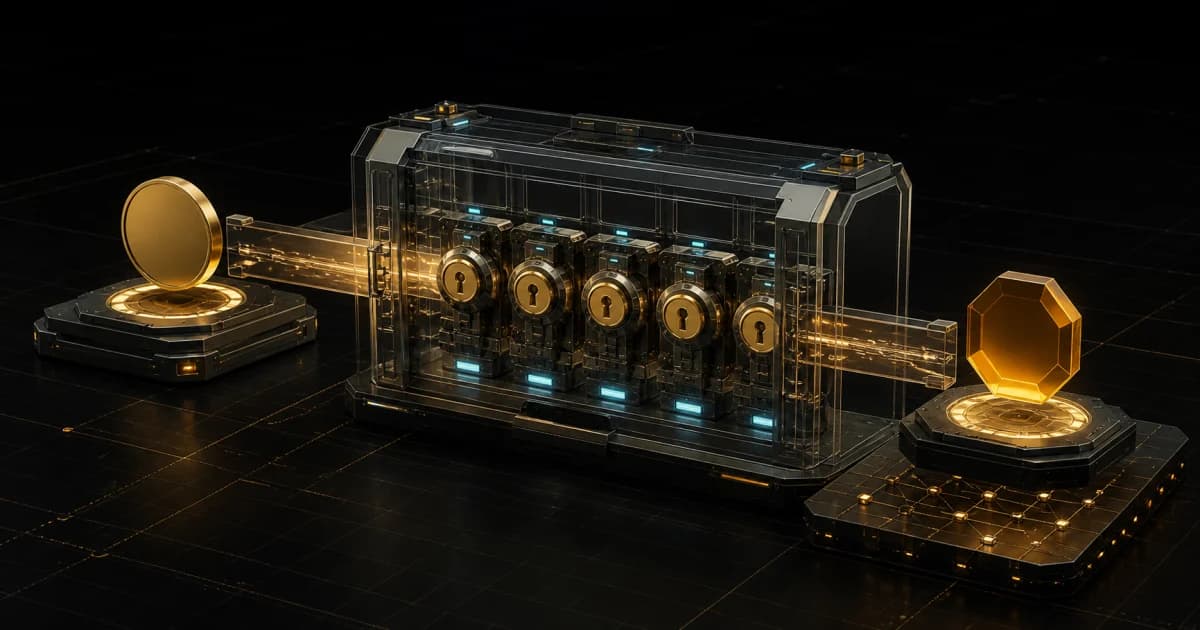
The dogechain bridge gives you a deposit address before it gives you an onchain EVM transaction. That is the clue: native DOGE enters a custody and signer process, then a represented balance is minted on Dogechain after confirmation. The current bridge interface warns that deposits below 100 DOGE can be lost and that only Dogecoin should be sent.
Verify the domain, minimum, address type, transaction status, and exit path before sending DOGE.
What the bridge creates
Dogecoin and Dogechain are different networks.
Native DOGE lives on the Dogecoin proof-of-work chain and uses Dogecoin addresses. Dogechain mainnet is an EVM-compatible chain with chain ID 2000, JSON-RPC endpoints, smart contracts, and Ethereum-style 0x addresses. A bridge connects their accounting.
You send native DOGE to an address controlled by the bridge service. After the service recognizes enough Dogecoin confirmations, administrators attest to the deposit and call the Dogechain bridge contract. The contract credits the corresponding representation to the EVM recipient you selected.
The official Dogechain bridge documentation uses the word “centralized.” That matters. Your deposit temporarily depends on operators identifying it correctly and on custody reserves remaining available for redemptions.
- 01
Deposit
Send at least the displayed minimum of native DOGE to the unique address revealed by the official bridge.
- 02
Confirm
Wait for the required Dogecoin block confirmations. The live interface currently states six.
- 03
Mint
Bridge administrators sign the observed deposit and the contract credits the EVM recipient.
- 04
Redeem
A withdrawal burns the represented DOGE and requests native DOGE from bridge custody.
This is different from swapping DOGE for an unrelated token. The economic goal is a redeemable representation, though redemption depends on bridge operations. If the bridge pauses, the Dogechain balance can continue to exist while the exit becomes delayed.
Before sending anything
Start from the Dogechain network overview, which lists the official mainnet bridge and RPC. Search ads and direct messages are poor navigation tools for a transaction that exposes a large balance.
If the official documentation or bridge interface will not resolve, stop there. A cached search result can help with research, but it is a poor launch point for a live transfer because it cannot prove that the service is operating or that its deposit instructions remain current.
Prepare two wallets. A Dogecoin wallet sends native DOGE. An EVM wallet receives the represented balance on Dogechain. The receiving address usually begins with 0x; a Dogecoin destination uses Dogecoin's own address format.
Add Dogechain mainnet using values from the current docs:
| Field | Current documented value |
|---|---|
| Network | Dogechain Mainnet |
| Chain ID | 2000 |
| RPC | https://rpc.dogechain.dog |
| Explorer | https://explorer.dogechain.dog |
| Gas asset | DOGE representation on Dogechain |
Wallet network settings can change. Copy them from the official documentation on the day you use them. A random “Add network” popup can insert a hostile RPC that lies about balances and transactions.
How to bridge DOGE into Dogechain
Verify the official domain
Open the bridge link from Dogechain documentation. Check every character in the hostname before connecting your EVM wallet or revealing a deposit address.
Connect the Dogechain recipient wallet
Select the EVM address that should receive the bridged representation. Confirm Dogechain mainnet and chain ID
2000in the wallet.Reveal the Dogecoin deposit address
Choose Deposit and record the displayed Dogecoin address. Confirm that the recipient shown beside it is your EVM address. A screenshot can help with later support, but do not include private keys or seed words.
Check the live minimum
The interface inspected for this guide says at least
100 DOGE; an amount below the minimum may fail to mint and can be lost. Leave room for the sending wallet's Dogecoin network fee.Send a controlled test
Use native DOGE on the Dogecoin network. Do not send an exchange's wrapped token or any other asset. For a larger transfer, test with an amount just above the live minimum and complete the full cycle first.
Track Dogecoin confirmations
Save the transaction ID and check it in a Dogecoin block explorer. The current bridge page requires six block confirmations before treating the deposit as valid.
Track bridge status
Use the bridge account/history view. When the bridge marks the record complete, confirm the Dogechain balance and transaction in the Dogechain explorer.
Preserve gas for the exit
Keep enough represented DOGE on Dogechain to pay for an eventual withdrawal transaction. Avoid deploying the full balance into a protocol whose token cannot be withdrawn independently.
The first transaction moves value away from an address controlled solely by you. Double-check the deposit address on the wallet's confirmation screen, not only on the clipboard. Clipboard malware can replace an address between copy and paste.
Minimums, confirmations, and timing
The live bridge page currently warns that a deposit under 100 DOGE will not trigger minting. The docs give the same minimum. Treat 100 as a hard floor rather than a suggested size.
Six Dogecoin confirmations establish that the deposit has enough proof-of-work depth for the bridge's policy. Dogecoin's block target is about one minute, but six confirmations do not guarantee a six-minute end-to-end bridge. Blocks vary, and operator processing happens afterward.
| Stage | What you can verify | Main delay source |
|---|---|---|
| Dogecoin broadcast | Transaction ID appears | Wallet broadcast and fee policy |
| Confirmation | Block count rises | Dogecoin block production |
| Bridge processing | Status record appears | Indexing and operator signatures |
| Dogechain mint | EVM transaction succeeds | Signer threshold and chain inclusion |
Do not resend because the minted balance is late. A second send creates a second deposit. Check the native transaction ID and bridge history, then contact official support with public transaction data if processing remains stalled.
I compared the current bridge page with Dogechain's architecture page and older official walkthrough. The interface still displays the 100 DOGE floor and six-confirmation rule. The older walkthrough contains more specific withdrawal fee and hot-wallet timing language, so those details are presented as dated terms rather than permanent promises.
How to withdraw back to Dogecoin
An exit runs the accounting in reverse. Connect the EVM wallet, choose Withdraw, enter the amount, and paste the native Dogecoin receiving address. The Dogechain contract burns or removes the represented balance, then the bridge service sends native DOGE from custody.
Read the destination twice. A Dogecoin transfer is irreversible, and an EVM 0x address does not belong in the Dogecoin recipient field.
Older official Dogechain withdrawal instructions documented a 100 DOGE minimum and 0.1 DOGE no-spam fee. They also said redemption could take a couple of days when the hot wallet needed a cold-storage top-up approved by a 3-of-5 multisig. The present interface is authoritative for the transaction you are about to sign.
Before burning the represented asset, capture:
- the net native DOGE the interface promises;
- Withdrawal address. Compare its first six and last six characters with the address in your Dogecoin wallet;
- current fee and minimum;
- an estimated processing range, if shown;
- a bridge withdrawal or burn transaction hash.
The burn can succeed before native DOGE arrives. That intermediate state is uncomfortable but structurally possible. Follow the history record and avoid initiating a duplicate withdrawal.
The custody equation
Let R be native DOGE held by the bridge and W be represented DOGE issued on Dogechain. A fully backed bridge aims for R >= W, after accounting for fees and pending flows.
Users usually cannot verify every custody detail from the frontend alone. Reserve addresses, cold storage, pending deposits, queued withdrawals, and administrative controls all affect the real equation. A matching token price is useful market evidence; it is not proof of reserves.
Suppose 1,000 represented DOGE trades at a 4% discount during a withdrawal delay. Selling immediately returns value equivalent to about 960 DOGE before trading costs. Waiting for redemption targets the bridge's stated 1:1 accounting, while adding time and operator exposure. That is a decision between observable market liquidity and bridge performance.
Wrapped DOGE adds a claim on the bridge
Holding native DOGE in a self-controlled Dogecoin wallet exposes you to Dogecoin and key-management risk. Moving it through Dogechain adds custody operators, signers, bridge contracts, an EVM chain, and any app you use afterward.
Risks to price separately
Custody. Native DOGE backing sits under bridge-controlled wallets. Operational failure, compromise, or insufficient liquid reserves can delay or impair redemption.
Signer concentration. Official documentation says multiple administrators approve deposits after a majority threshold. Users rely on their availability and honest behavior.
Smart contracts. The mint and burn logic can fail even when custody is intact. Dogechain publishes a security audit, though an audit covers a version and scope.
Chain security. Dogechain has its own validator and governance system. Activity on an EVM chain does not inherit Dogecoin proof-of-work security simply because DOGE backs the gas asset.
App risk. A DEX, farm, NFT contract, or lending app can lose the represented DOGE without the bridge failing. Check contracts with the crypto due-diligence guide.
Identity confusion. Dogechain, Dogecoin, and the long-running dogechain.info explorer/wallet name are easy to mix up. This guide concerns the EVM-compatible network documented at docs.dogechain.dog.
When the bridge makes sense
The route has a specific purpose: using native DOGE value inside Dogechain applications. It may fit a user who has identified an app, sized the contract risks, and established a working exit.
It fits poorly when someone merely wants to hold DOGE. Native custody avoids the bridge dependency. It also fits poorly when the balance is near the minimum because network costs and the inability to run a smaller test make error recovery harsher.
For speculation, include the exit in the entry plan. Yield displayed in another token can fall while represented DOGE depegs or the bridge pauses. Read yield-farming risks before approving a farm, and inspect permissions with the token approval checker.
Troubleshooting
Deposit has fewer than six confirmations
Wait and inspect the Dogecoin transaction. The bridge cannot accelerate Dogecoin blocks. Do not replace or resend unless your wallet provides a valid Dogecoin-specific recovery procedure and you understand its transaction model.
Six confirmations passed but nothing minted
Check the bridge history, recipient EVM address, and Dogechain explorer. Record the Dogecoin transaction ID plus the revealed deposit address. Use official support channels from the documentation.
Deposit was below 100 DOGE
The live page says an under-minimum deposit can be lost. Do not send a second amount assuming the bridge will combine them unless official support confirms that behavior for your exact deposit address.
Wrong asset was sent
Stop. Another asset sent to the Dogecoin deposit address may be unrecoverable. Do not trust private messages offering recovery, and never reveal a seed phrase.
Withdrawal burn succeeded but DOGE has not arrived
Check the withdrawal status and hot-wallet notices. Older official guidance allows for multi-day processing during a cold-storage top-up. Share only public transaction identifiers with verified support.
Dogechain bridge checklist
- I opened the bridge from official Dogechain documentation.
- I understand Dogecoin and Dogechain are separate networks.
- Chain ID
2000and the current RPC came from the docs. - The revealed deposit address is a Dogecoin address, and my recipient is the intended
0xwallet. - I am sending only native DOGE through the Dogecoin network.
- The amount exceeds the minimum displayed right now.
- I saved the Dogecoin transaction ID and deposit record.
- Six confirmations have passed before I escalate a delay.
- I tested the complete deposit and withdrawal cycle before using a large amount.
- I have preserved Dogechain gas and reviewed every app approval.
If you only do three things
- Use only the bridge domain linked by official Dogechain docs, then verify chain ID
2000. - Send native DOGE above the live minimum and save the transaction ID.
- Test redemption to a Dogecoin address before committing money you cannot afford to have delayed.
Dogechain bridge FAQ
›Is the Dogechain bridge decentralized?
Dogechain's own documentation describes its native DOGE bridge as centralized. Administrators observe deposits, sign confirmations, and participate in the minting process.
›What is the minimum Dogechain bridge deposit?
The official interface and documentation currently state 100 DOGE. The interface warns that a smaller deposit can fail to mint and be lost. Verify the displayed minimum before every transfer.
›How many confirmations does the Dogechain bridge require?
The current official bridge page says six Dogecoin block confirmations are required before a deposit is considered valid.
›How long does a Dogechain withdrawal take?
Timing varies. Older official guidance says redemption can take a couple of days if the hot wallet needs a 3-of-5 cold-storage top-up. Read the current bridge status before burning represented DOGE.
›Can I send an ERC-20 token to the DOGE deposit address?
No. The bridge warns users to send only native Dogecoin. Another asset or network can result in permanent loss.
Sources and methodology
The operational claims in this guide come from Dogechain's live bridge interface, official bridge architecture, mainnet overview, whitepaper, and dated deposit and withdrawal walkthrough. Current interface warnings take priority over old screenshots.
DeFi Farmer does not operate the bridge and cannot recover deposits. This is technical education rather than a recommendation to bridge or trade. Keep assets required for living expenses away from experimental chains and contracts.
Keep reading
Related research
Is VeChain Supported on Trezor?
Is VeChain supported on Trezor wallet devices? No, as of September 9, 2026. See safe VET storage options and how to transfer crypto to a Trezor.
Best Ripple Hardware Wallet
Best Ripple hardware wallet picks for XRP self-custody: Ledger, Trezor, Tangem, and Ellipal compared with US prices, reserve rules, and safe receiving steps.
Trezor Wallet Review
Trezor wallet review: current lineup with US prices, secure element and backup differences by model, coin support gaps, and scam warnings.
Ledger Nano X Review
Ledger Nano X crypto hardware wallet reviews: dated $99 price check, full specs, Bluetooth security, battery limits, and how it compares with the Nano S Plus and Flex.
Get the next field guide
New protocol research, risk checks, and practical DeFi tools.