Gnosis to ETH Bridge
Use the Gnosis to ETH bridge safely: choose WETH, xDAI, or a third-party route; estimate fees; claim on Ethereum; and troubleshoot delays.

DeFi Farmer Research Desk
Aug 28, 2026 · 12 min read
In brief. For WETH on Gnosis Chain, the official Omnibridge can release native ETH on Ethereum. Confirm both token contracts, budget Gnosis and Ethereum gas, check live limits, and complete the Ethereum claim when the bridge asks for it.
On this page16 sections
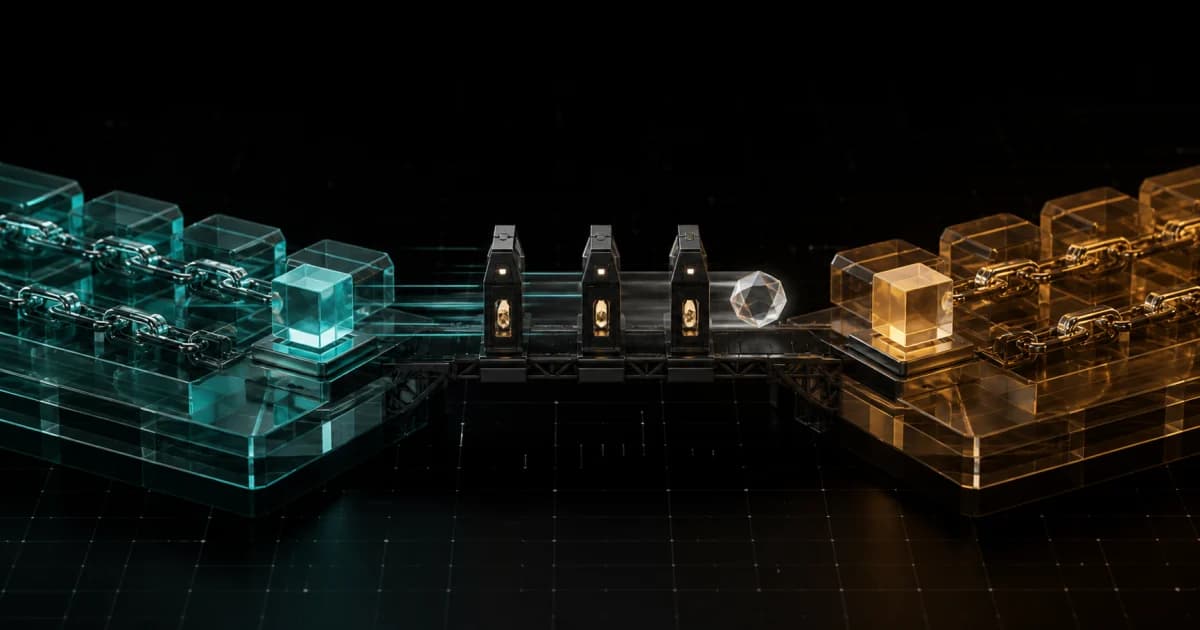
The gnosis to eth bridge route has one detail that catches people late: a Gnosis-to-Ethereum transfer may require a separate claim transaction on Ethereum. For WETH, the official Gnosis Bridge says it unwraps the asset and releases native ETH on Ethereum. Check the live quote, destination asset, bridge limits, and both gas balances before approving anything.
Confirm the asset contract, receiving token, claim step, limits, and gas before moving funds.
Pick the result you need
“Move value to Ethereum” leaves out the destination asset. That omission can turn a simple bridge into two or three transactions.
If you hold WETH on Gnosis Chain and want native ETH on Ethereum, the official Omnibridge is the direct canonical route. Gnosis Chain's bridge FAQ states that WETH is automatically unwrapped during this direction, so the Ethereum wallet receives ETH.
If you hold xDAI, the native xDai Bridge handles the stablecoin path. Current documentation describes the Ethereum-side migration around USDS and DAI. The interface preview should name the precise asset you receive. You would then swap that stablecoin into ETH on Ethereum if ETH is the final goal.
Other ERC-20 tokens use Omnibridge when supported. Some emerge under a representation specific to their origin. Contract addresses are the reliable identity; tickers can collide.
| Starting balance on Gnosis | Likely official path | Ethereum result | Extra action |
|---|---|---|---|
| WETH | Omnibridge | Native ETH | Claim when prompted |
| xDAI | xDai Bridge | DAI or USDS route shown live | Swap to ETH afterward |
| Supported ERC-20 | Omnibridge | Canonical Ethereum token when unlocked | Claim when prompted |
| Unsupported or small asset | Aggregator or swap first | Route-specific | Compare total output |
Do a tiny transfer when an asset representation is unfamiliar. It costs another round of gas, but a small operational test can be rational for a large balance.
How the official bridge moves WETH
Omnibridge is built over the Arbitrary Message Bridge. The official Omnibridge documentation lists a 4-of-7 validator multisignature trust model and 8-of-15 governance multisig. The destination transaction happens after the required bridge validators attest to the message.
On the Gnosis side, your WETH moves into the mediator flow. The bridge burns the Gnosis representation, emits a message request, and validators sign that request. On Ethereum, a user-submitted claim executes the collected signatures and unlocks the original asset. For WETH, the supported interface unwraps it into ETH.
- 01
Initiate
Select Gnosis as source, Ethereum as destination, and verify that WETH becomes ETH in the final preview.
- 02
Validate
Bridge validators observe the Gnosis event and collect the threshold of signatures.
- 03
Claim
Submit the prepared bridge message on Ethereum when the interface marks it ready.
- 04
Verify
Confirm the Ethereum receipt, received ETH balance, fee, and destination address before closing the record.
The claim matters. A Gnosis-side transaction can show success while the asset waits for Ethereum execution. Search the Bridge Explorer with the source transaction hash instead of repeating the bridge deposit.
Step-by-step official route
Open the verified bridge
Follow the bridge link from official Gnosis Chain documentation. Check the full domain before connecting. Avoid the legacy Omnibridge URL, which the current documentation explicitly tells users to avoid.
Choose Gnosis and Ethereum
Set Gnosis Chain as the source and Ethereum as the destination. Let the wallet switch networks, then confirm chain ID
100for Gnosis and chain ID1for Ethereum.Select WETH and inspect the output
Enter the amount. The receiving line should show native ETH for the supported WETH exit. If it shows another token, pause and identify that contract before continuing.
Check balance, limits, and fees
Leave xDAI for Gnosis gas. Review the bridge fee, current minimum and maximum, daily capacity, and estimated Ethereum claim gas. The Limits control and Bridge Explorer provide live values.
Submit on Gnosis
Read the wallet request. Confirm the destination address, amount, and bridge mediator. Save the transaction hash after it lands.
Wait for message validation
Monitor the bridge record. The official FAQ gives about 20 minutes as an ordinary estimate, though congestion, capacity, validator availability, or an incident can extend it.
Claim on Ethereum
Switch to Ethereum when the bridge enables Claim. Confirm the claim transaction and pay Ethereum gas. Do not send another Gnosis transaction because the balance has not appeared yet.
Reconcile the receipt
Compare starting WETH, bridge fee, gas on both chains, and final ETH received. Remove obsolete approvals if one was created during an alternate token route.
What the transfer costs
Three costs can appear.
The first is Gnosis gas, paid in xDAI. It is normally small, though “small” does not mean zero. Keep enough xDAI outside the amount you plan to move.
The bridge's limits page documents a default 0.1% fee for Gnosis-to-Ethereum transfers. At that rate, bridging 2 WETH costs 0.002 WETH before gas. A 25 WETH transfer costs 0.025 WETH. Treat those as illustrations because bridge governance can update parameters.
Ethereum claim gas is the third cost. It is paid in ETH. The awkward case is obvious once it happens: all of your ETH sits behind an unclaimed message, but the wallet has no ETH to execute the claim. Keep a small destination balance or arrange a trusted source of Ethereum gas.
| Example amount | Fee at 0.1% | Amount before gas |
|---|---|---|
| 0.50 WETH | 0.0005 ETH | 0.4995 ETH |
| 2.00 WETH | 0.0020 ETH | 1.9980 ETH |
| 10.00 WETH | 0.0100 ETH | 9.9900 ETH |
| 25.00 WETH | 0.0250 ETH | 24.9750 ETH |
For a small transfer, the fixed Ethereum claim gas can dominate. Compare final ETH received, including both gas payments, against an aggregator quote. Do not compare percentage bridge fees in isolation.
Limits and waiting time
Bridge limits exist per token, per transaction, and per day. The exact values are contract state. Gnosis documentation explains how to read minPerTx, maxPerTx, dailyLimit, and execution counterparts from the mediator contracts.
Daily limits reset at 00:00 UTC, according to the bridge FAQ. A transaction above remaining capacity may wait rather than fail cleanly. Read the live Limits panel before sending a large amount.
The documentation currently estimates around 20 minutes for Omnibridge validation using its light-client verification path. That estimate is a baseline. Ethereum congestion can make the claim expensive without slowing the signature threshold itself, and an operational pause can delay execution.
The current Gnosis pages agree on the canonical bridge domain, the separate Ethereum claim, and the approximate validation window. They also expose live limits rather than promising permanent numbers. I would use those contract values on the day of transfer and save the quote beside both transaction hashes.
Canonical bridge or aggregator
An aggregator can route through third-party liquidity and perform a destination swap. That can be useful when the amount is small, Ethereum gas is high, or the desired result is another token.
The canonical bridge has a defined validator and governance model. An aggregator may add a router, a liquidity network, relayers, and a destination DEX. Faster settlement can come from inventory advanced by liquidity providers rather than canonical finality.
Compare these fields before choosing.
- Final asset and its contract address. A familiar ticker does not establish equivalence.
- Total output. Include the source gas estimate, protocol fee, bridge fee, slippage, destination gas, and any integrator charge.
- Who can pause, upgrade, or redirect the route.
- Failure recovery. Determine whether funds refund automatically, require a support ticket, or wait for canonical settlement.
- Liquidity at your exact size. A route that wins for
$200can lose at$20,000.
Gnosis Chain's FAQ suggests its native bridge for larger transfers and mentions third-party routes for smaller amounts or other networks. That is a useful starting distinction, not a permanent price rule.
Risks that remain after a successful preview
Validator risk. Omnibridge depends on the documented validator threshold. A threshold compromise, outage, or disagreement can affect messages.
Governance risk. An 8-of-15 multisig can update contracts and parameters. The bridge-management page lists governors and their powers.
Contract risk. The mediator, AMB, token contract, and interface form a system. Past audits reduce uncertainty; they cannot prove future safety.
Representation risk. Bridged tokens may carry different contracts across chains. Gnosis documentation specifically warns about multiple representations and deprecated routes.
User error. A correct bridge cannot recover an incorrect destination, unsupported token, or signature granted to a lookalike site. Read what bridging in crypto means before your first cross-chain transfer.
A successful source transaction is only half the record
Do not initiate the transfer again when the Ethereum balance is missing. Search the Bridge Explorer, wait for the message to become claimable, and execute the existing claim.
Troubleshooting
The transfer says pending
Open the Bridge Explorer and check which stage is pending. If signatures are still collecting, wait. If the message is ready, switch the wallet to Ethereum and look for the Claim action.
Claim is ready but the wallet cannot submit
Check native ETH for gas and verify chain ID 1. Raising gas wildly does not fix an empty ETH balance. Fund the destination wallet through a route you control, then return to the existing claim.
The amount exceeds a limit
Read current capacity in the Limits panel. Avoid splitting automatically; per-transaction minimums, multiple fees, and daily capacity still apply. Waiting until after the UTC reset can be cleaner.
The received token looks wrong
Compare the destination contract with the canonical token registry. Do not trade or approve it until the contract is identified. Scam tokens often reuse names and icons.
The old Omnibridge page appeared in search
Leave it. Current official docs say to avoid the legacy Omnibridge and use the unified Gnosis Bridge interface.
Gnosis bridge checklist
- I reached the current bridge through official Gnosis documentation.
- Source is Gnosis Chain, chain ID
100; destination is Ethereum, chain ID1. - I verified the source token contract and the exact destination asset.
- WETH shows native ETH as output, if that is the route I intend.
- My wallet retains xDAI for source gas and ETH for the destination claim.
- The amount fits current per-transaction and daily limits.
- I recorded the bridge fee and estimated both network fees.
- The destination address is correct and controlled by me.
- I saved the Gnosis transaction hash and will claim the same message.
- A test transfer is complete before the large transfer.
If you only do three things
- Verify the current
bridge.gnosischain.comdomain through official documentation. - Check the output asset and keep ETH available for a separate Ethereum claim.
- Save the source hash, then follow that message in the Bridge Explorer until the final receipt succeeds.
Gnosis to ETH bridge FAQ
›Can I bridge WETH from Gnosis Chain and receive native ETH?
Yes. The official Gnosis bridge FAQ says Omnibridge automatically unwraps WETH from Gnosis Chain and releases ETH on Ethereum. Confirm the live preview before signing.
›Do I need to claim a Gnosis-to-Ethereum bridge transfer?
The official flow requires an Ethereum-side claim after bridge validation. Monitor the source transaction in the Bridge Explorer and use its Claim action rather than starting a second transfer.
›How long does the Gnosis bridge take?
Gnosis documentation gives roughly 20 minutes as an ordinary Omnibridge estimate. Limits, validator operations, congestion, or incident response can extend that time.
›What is the Gnosis-to-Ethereum bridge fee?
The official limits page documents a 0.1% default bridge fee in that direction, plus gas on Gnosis and Ethereum. Verify the current interface because governance can change bridge parameters.
›Does xDAI become ETH on Ethereum?
No direct conversion should be assumed. xDAI uses the stablecoin bridge route shown in the live interface. If ETH is the goal, a separate stablecoin-to-ETH swap may be needed.
Sources and methodology
This guide was checked against Gnosis Chain's official bridge instructions, Omnibridge architecture, xDai Bridge documentation, limits page, and bridge governance. Numerical examples are arithmetic illustrations, not live quotes. Recheck the interface and contract state on the day you transfer.
DeFi Farmer publishes independent educational research and does not custody assets or operate this bridge. Cross-chain transfers can be delayed or lost. Use a test amount and seek qualified tax or legal advice where a transfer has reporting consequences.
Keep reading
Related research
Is VeChain Supported on Trezor?
Is VeChain supported on Trezor wallet devices? No, as of September 9, 2026. See safe VET storage options and how to transfer crypto to a Trezor.
Best Ripple Hardware Wallet
Best Ripple hardware wallet picks for XRP self-custody: Ledger, Trezor, Tangem, and Ellipal compared with US prices, reserve rules, and safe receiving steps.
Trezor Wallet Review
Trezor wallet review: current lineup with US prices, secure element and backup differences by model, coin support gaps, and scam warnings.
Ledger Nano X Review
Ledger Nano X crypto hardware wallet reviews: dated $99 price check, full specs, Bluetooth security, battery limits, and how it compares with the Nano S Plus and Flex.
Get the next field guide
New protocol research, risk checks, and practical DeFi tools.