Trezor Support Number
There is no Trezor wallet support number. Learn the real Trezor customer service channels, the fake-number scam, and what to do if you shared your seed.

DeFi Farmer Research Desk
Sep 14, 2026 · 13 min read
In brief. Trezor does not offer public phone support, so any number claiming to be Trezor support is a scam. Reach support only through trezor.io/support, its Chatbot Hal, Trezor Suite, and the official forum. If you already shared your recovery seed, move your funds to a wallet with a new seed immediately.
On this page12 sections
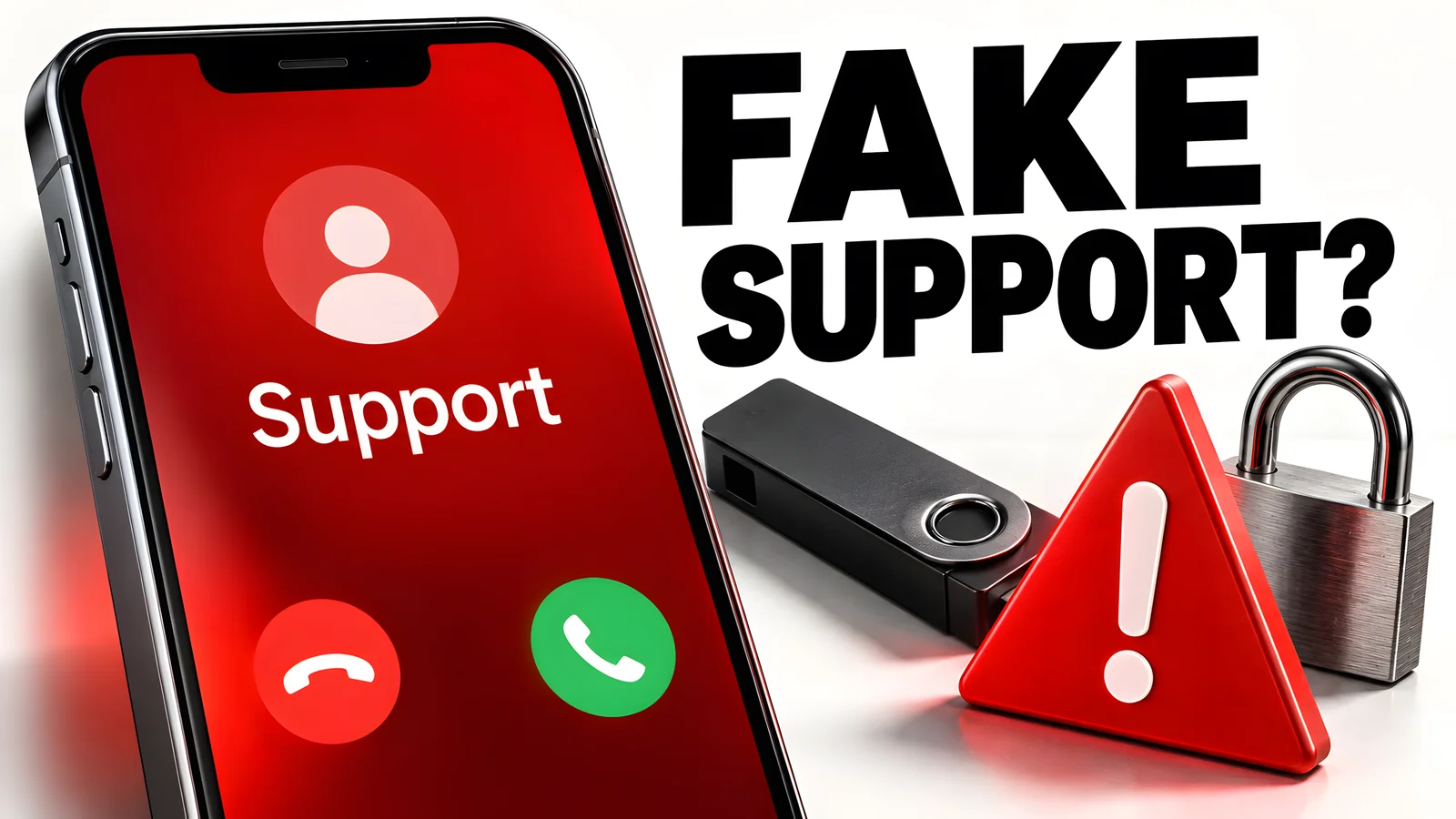
Searching for a Trezor wallet support number leads to scammers, because Trezor does not offer public phone support. Any number in a search ad, directory listing, forum reply, or social post claiming to connect you to Trezor is fake. Real support starts at the official support page, its Chatbot Hal, the Trezor Suite app, and the Trezor forum.
Official channel and incident check: September 9, 2026. This is desk research from official Trezor pages and the original research posts. We did not call any listed number, and you should not either.
If you are on the phone right now
Hang up. Trezor's official guidance says to hang up immediately on anyone claiming to be from a hardware wallet company, then open a ticket through Chatbot Hal. If you typed your seed words during the call, skip to the recovery steps and move your funds now.
Real Trezor channels vs fake ones
Check this table before you trust any "Trezor support" contact. We verified the official pages on September 9, 2026.
| Channel | Real or fake | What to know |
|---|---|---|
| trezor.io/support and Chatbot Hal | Real | Official entry point; Hal opens tickets and escalates to the team. |
| Trezor Suite app | Real | Download only from trezor.io; fake Suite clones are a known phishing tool. |
| forum.trezor.io | Real | Community forum linked from the support page. |
| Emails from trezor.io addresses | Real sender, verify anyway | A January 2024 incident sent phishing from a genuine Trezor address. Never act on any email asking for your seed. |
| Phone numbers in ads or directories | Fake | Trezor lists no phone support anywhere. |
| Telegram, WhatsApp, SMS, or postal contact | Fake | Trezor states it never contacts users through these methods. |
| "Support agents" in social replies and DMs | Fake | Impersonators watch comment sections and answer with numbers or links. |
When we checked trezor.io/support, it offered a knowledge base, a chat entry point, and a forum link. No phone number or public support email appeared anywhere on it. A top-ranking third-party directory did list a "most popular Trezor phone number" with a call button. Trezor operates no such line; treat every number like it as hostile.
How to reach Trezor customer service
Go to trezor.io/support by typing the address or using a bookmark, never through a search ad. Open Chatbot Hal, describe the problem, and let it create a ticket; to report phishing, type "I want to report phishing". Most device problems have documented fixes in the troubleshooting articles, and order questions live in the portal's logistics section.
Strangers on the forum can still be scammers. Nobody legitimate moves the conversation to a phone call, a Telegram chat, or a "verification" website. If you are comparing wallets rather than fixing one, our Trezor wallet review and best hardware wallets for 2026 cover the devices.
How the fake support number scam works
- 01
The bait
A search ad, directory page, or forum reply lists a Trezor support number.
- 02
The call
A polished agent answers, greets you by name, and says your wallet has a problem.
- 03
The pretext
You must sync, validate, or secure the wallet before it is deactivated.
- 04
The theft
You read out seed words, type them into a fake page, or send a verification transfer.
- 05
The drain
The scammer restores your wallet elsewhere and moves every asset. Transfers are final.
The caller may know your name and email. That proves nothing: contact details leak in breaches, and the 2024 incidents below document one source. Scammers use AI-generated voices, so a convincing call means nothing either. Trezor's rule is blunt: any request for your wallet backup, PIN, passwords, or codes is always a scam. The same playbook shows up in our digital wallet scam guide, and the fake-airdrop variant in crypto airdrop scams.
What real Trezor support will never ask for

Trezor states it will never ask for your recovery seed over email, customer support, or any other channel. Real support will never:
- Ask for your 12, 20, or 24 recovery words, in any form, for any reason.
- Ask for your passphrase or device PIN.
- Ask you to install remote-access or screen-sharing tools.
- Ask for a "verification" or "synchronization" transfer.
- Contact you first by phone, SMS, WhatsApp, Telegram, or postal letter.
- Threaten to deactivate your device; Trezor says it cannot and will not.
If a "solution" requires revealing secrets or sending funds, it is not support. A legitimate fix involves your device's own screen, the official Trezor Suite, and the knowledge base.
Was Trezor hacked?
This question mixes three different events. Here is the honest split, with dates.
Physical extraction research on old models
In July 2019, Ledger's Donjon team published a seed-extraction attack on the Trezor One, Trezor Model T, and clones: an attacker with a stolen device could pull the seed in under five minutes with roughly $100 of equipment, and no firmware update could fix it. In January 2020, Kraken Security Labs showed a voltage-glitching attack on the same models needing about 15 minutes of physical access. Both attacks need your device in hand and lab-style equipment; neither is a remote hack, and neither explains funds vanishing from a device still in your drawer.
The 2024 support and email incidents
On January 17, 2024, an unauthorized party accessed the third-party support ticketing portal Trezor used. Per Trezor's disclosure, contact details of up to 66,000 people who had contacted Trezor Support since December 2021 may have been exposed, limited to names or nicknames and emails. The intruder emailed 41 users directly asking for recovery-seed information; Trezor reports no seeds were disclosed and no funds were affected. On January 24, a separate incident sent a phishing email titled "Assets undergoing upgrade" to Trezor's newsletter database through a compromised email vendor, from a genuine Trezor address.
Support contacts potentially exposed
66,000
Names and emails only, per Trezor's January 2024 disclosure
Users emailed directly by the intruder
41
Asked for seed information; Trezor says none shared it
Seeds or funds compromised
0
Both incidents hit third-party vendors, not Trezor devices
These incidents put your inbox and phone in the line of fire, not your device. They explain why a fake "Trezor agent" can greet you by name.
The "Trezor stole my funds" panic
Trezor cannot move your funds. The wallet holds keys; assets live on their networks, and only a valid signature moves them. No support channel can freeze, reverse, or reroute a transfer. When people believe Trezor took their money, the real cause is a seed typed into a phishing page, a seed read to a fake agent, malware, or a misunderstood signature. Our seed phrase storage guide covers the backup side.
If you already called a fake number or shared your seed
Act as if the theft is already scheduled, because it is. Minutes matter, but stay methodical.
End all contact
Hang up, block the number, and close any page or remote-access tool the caller asked you to open. Do not call back; the same operation answers.
Create a new wallet with a new seed
Reset your Trezor or set up a second hardware wallet, and generate a brand-new recovery seed. Never type the new words into a computer, phone, or form. Write them down offline.
Verify the new backup
Record the words carefully and run the official backup check in Trezor Suite before moving anything. If you add a passphrase, test recovery of the exact account you plan to use.
Move every asset to the new wallet
Send funds to addresses under the new seed, most valuable first. Verify each receiving address on the device screen, and sweep tokens on every network you use.
Secure your other accounts
If you shared personal details, change email and exchange passwords and review two-factor settings. Expect follow-up phishing that references this call.
Report the attempt
Changing your PIN or wiping the old device does not help: the old seed controls the old addresses until every asset leaves them.
Common mistakes and edge cases
- "The caller knew my name, so it was real." Contact data leaks constantly, including in Trezor's January 2024 incident. A greeting proves nothing.
- "I clicked the link but typed nothing." Per Trezor's guidance, clicking alone does not compromise funds. Stay alert and do not return to the page.
- "Support wanted screen sharing for diagnostics." Real Trezor support does not take remote access to your computer.
- "I gave my seed but the balance is still there." The scammer may be waiting for a bigger deposit. Move funds now.
- "I bought my Trezor from a marketplace seller." Buy from the official shop or verified resellers; our guide on where to buy a hardware wallet explains why. A pre-filled recovery card in the box is a scam by itself.
Printable safety checklist
- I reach Trezor only through trezor.io/support, Chatbot Hal, Trezor Suite, or the official forum.
- I treat every phone number, DM, text, or letter claiming to be Trezor as a scam.
- I never type seed words into a website, chat, form, or AI tool, and never read them aloud.
- I ignore any threat that my device will be deactivated.
- I download Trezor Suite only from trezor.io and verify addresses on the device screen.
- My recovery seed is stored offline and I have checked the backup.
- If I ever share a seed, I move funds to a new wallet with a new seed immediately.
Trezor Support Questions
›Does Trezor have a phone number?
No. Trezor does not offer public phone support, and its official support page lists no phone number. Any number in ads, directories, forums, or social posts claiming to be Trezor support is a scam, and Trezor's own guidance is to hang up on anyone claiming to be Trezor on the phone.
›How do I contact Trezor support?
Start at trezor.io/support and use Chatbot Hal to describe your issue and open a ticket. The Trezor forum covers community questions, and the knowledge base handles most device problems. Type the address directly or use a bookmark instead of clicking search ads.
›Is the Trezor Suite chat legit?
Chatbot Hal, reached through trezor.io/support or the official Trezor Suite, is the legitimate support entry point. The risk is lookalike sites and cloned apps, so download Suite only from trezor.io and check the address bar. Even the real chat will never ask for your recovery seed.
›Was Trezor hacked?
Three different events get mixed up. In 2019 and 2020, Ledger Donjon and Kraken Security Labs demonstrated physical seed-extraction attacks on the Trezor One and Model T that require the stolen device and lab equipment. In January 2024, breaches at Trezor's support ticketing vendor and email vendor exposed contact details and enabled phishing, but Trezor reports no seeds or funds were compromised. No Trezor device was remotely hacked in any of these events.
›What if I gave my seed phrase to support?
You were talking to a scammer, and the seed is compromised. Create a new wallet with a new seed on a trusted device, verify the new backup offline, and move every asset to it right away on every network you use. Then report the number and links through Chatbot Hal and to the FTC or IC3.
›Why did the fake agent know my name and email?
Contact databases leak. Trezor disclosed in January 2024 that a breach at its third-party support ticketing provider may have exposed names and emails of up to 66,000 people who had contacted support. A caller knowing your details is evidence of a data leak, not legitimacy.
›Can Trezor reverse a transaction or freeze my wallet?
No. Trezor cannot deactivate your device, reverse transfers, or move funds. Self-custody transactions are final, which is why fake agents push urgency: once you send funds or reveal the seed, nobody can undo it.
Sources and review method
The DeFi Farmer Research Desk wrote this from primary sources checked on September 9, 2026: the official Trezor support portal, Trezor's scams and phishing guidance, the January 2024 support ticketing disclosure, the January 2024 newsletter phishing alert, Ledger Donjon's 2019 seed extraction research, and Kraken Security Labs' 2020 fault injection write-up.
This is desk research. We did not call any advertised support number, test any attack, or verify Trezor's internal findings beyond its public statements. Confirm current channels on trezor.io before acting. External links point only to official or primary sources and carry no affiliate parameters. The hero image is a custom editorial graphic, not product photography. This is general security education, not financial, legal, or investment advice.
Keep reading
Related research
Best Hardware Wallet 2026
Best hardware wallet 2026 compared: Ledger, Trezor, Coldcard, Keystone, Tangem, BitBox02, Jade, and OneKey with current US prices, chips, and backup formats.
Ledger Nano X Review
Ledger Nano X crypto hardware wallet reviews: dated $99 price check, full specs, Bluetooth security, battery limits, and how it compares with the Nano S Plus and Flex.
Where to Buy a Hardware Wallet
Searched 'ledger near me'? Buy from the maker's official store or an authorized retailer like Best Buy. Dated prices, Amazon risks, and scam checks.
Hardware Wallet vs Software Wallet
Hardware wallet vs software wallet: where each one stores your private key, what they cost, and which setup fits savings and airdrop farming.
Get the next field guide
New protocol research, risk checks, and practical DeFi tools.